
Idioms and Proverbs Related to Dishwashing: Apa Bahasa Inggrisnya Mencuci Piring

While there isn’t a vast collection of idioms specifically dedicated to the act of washing dishes, several English idioms touch upon the tediousness and often thankless nature of such chores, reflecting broader sentiments about mundane tasks and household responsibilities.
This section will explore one such idiom, examining its meaning, origin, usage, and comparing it with similar expressions.

The Idiom “A Sisyphean Task”
The idiom “a Sisyphean task” refers to a task that is endless and futile, constantly requiring repetition without any real progress or accomplishment. It derives from the Greek myth of Sisyphus, who was condemned by the gods to eternally roll a boulder up a hill, only to have it roll back down each time he neared the top. This unending cycle perfectly encapsulates the feeling of endlessly washing dishes, especially when dealing with a large family or frequent gatherings.
The idiom’s usage often highlights the frustrating and seemingly pointless nature of a repetitive chore. It’s not necessarily about the difficulty of the task itself, but rather the lack of tangible reward or sense of completion.
Example sentence: “Washing dishes after the holiday party felt like a Sisyphean task; as soon as I finished one load, another seemed to magically appear.”
The idiom “a Sisyphean task” is frequently used informally to describe a frustratingly repetitive job with little to no sense of progress. It adds a layer of dramatic irony, emphasizing the futility of the effort. For example, someone might say, “Cleaning up after the kids’ birthday party was a Sisyphean task,” highlighting the never-ending cycle of cleanup.

Comparison with similar idioms: While “a Sisyphean task” specifically references the myth of Sisyphus, other idioms convey a similar sense of endless, fruitless labor. “Chasing your tail” implies running around in circles achieving nothing, while “beating a dead horse” suggests persisting with a futile effort. These idioms share the common thread of emphasizing wasted effort and lack of progress, similar to the unending nature of washing dishes if viewed metaphorically.
English Vocabulary for Dishwashing Utensils
Washing dishes might seem like a mundane task, but understanding the vocabulary associated with it in English can be surprisingly helpful, whether you’re following a recipe with detailed instructions or simply communicating about household chores. This section will explore common English words for dishwashing utensils, their usage, and subtle differences in meaning.
List of Dishwashing Utensils and Their Descriptions
A variety of tools make dishwashing more efficient and effective. Familiarizing yourself with their English names is key to understanding instructions or communicating about the process. Below is a list of common dishwashing utensils:
- Plates: Flat, circular dishes for serving food.
- Spoons: Utensils with a bowl-shaped end for eating.
- Forks: Utensils with multiple tines for eating.
- Knives: Utensils with a sharp blade for cutting food.
- Dish soap/Washing-up liquid: The detergent used to clean dishes.
- Sponge: A porous material used for scrubbing.
- Dishcloth/Washing-up cloth: A cloth used for wiping dishes.
- Dish rack/Drainer: A rack for drying washed dishes.
- Dish brush: A brush specifically designed for cleaning dishes.
- Rubber gloves: Protective gloves worn while washing dishes.
Descriptive Paragraph on the Dishwashing Process
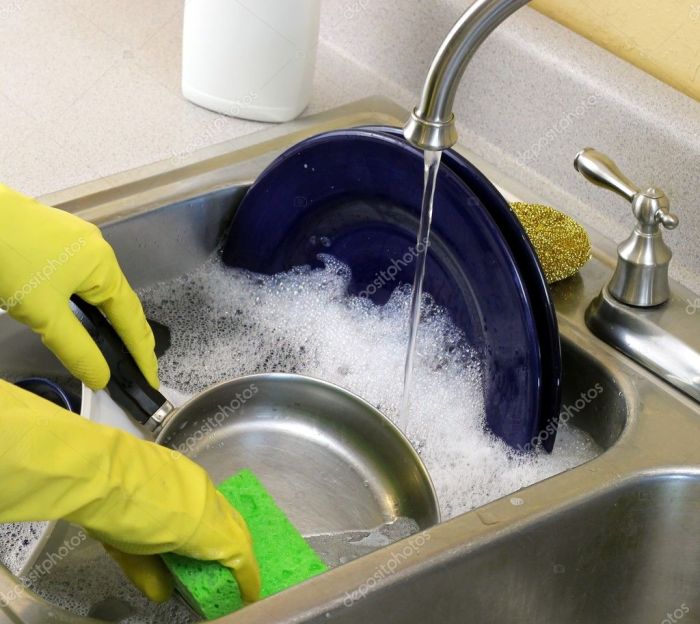
After a hearty meal, the dirty dishes – plates, spoons, forks, and knives – piled up in the sink. I donned my rubber gloves and squirted some dish soap onto a sponge. Then, I began washing each item meticulously, using warm water and scrubbing away any food residue. Finally, I rinsed the dishes thoroughly and placed them in the dish rack to air dry.
The used sponge and dishcloth went straight into the washing machine for a thorough clean.
Table of Dishwashing Utensils, Functions, and Example Sentences
| Utensil | Function | Example Sentence |
|---|---|---|
| Plates | Serving food | I carefully stacked the clean plates in the cupboard. |
| Spoons | Eating soup or stirring | He used a large spoon to serve the ice cream. |
| Forks | Eating solid food | She stabbed her fork into the steak. |
| Dish soap | Cleaning dishes | The lemon-scented dish soap left the dishes sparkling. |
| Sponge | Scrubbing dishes | I used a damp sponge to wipe down the counter. |
| Dishcloth | Drying dishes | The dishcloth was soaked after washing all the dishes. |
| Dish rack | Drying dishes | I carefully arranged the washed dishes in the dish rack. |
Example Sentence Using Five Dishwashing Utensils, Apa bahasa inggrisnya mencuci piring
After dinner, I washed the dirty plates, spoons, forks, knives, and used the sponge to clean the sticky residue from the counter before placing them in the dish rack to dry.
Differences in Similar Dishwashing Vocabulary
While terms like “dishcloth” and “sponge” might seem interchangeable, there are subtle differences. A dishcloth is typically a woven fabric used for wiping, while a sponge is a porous material better suited for scrubbing. Similarly, “dish soap” and “washing-up liquid” are essentially the same, with “washing-up liquid” being more commonly used in British English.
Penutupan Akhir

Memahami berbagai cara untuk mengatakan “mencuci piring” dalam bahasa Inggris memperkaya kemampuan berbahasa kita. Dari pilihan kata yang sederhana hingga idiom yang lebih bernuansa, kita telah melihat bagaimana konteks dan tingkat keakraban memengaruhi pilihan bahasa yang tepat. Dengan pengetahuan ini, kita dapat berkomunikasi dengan lebih efektif dan alami dalam bahasa Inggris, baik dalam percakapan sehari-hari maupun situasi formal.
Semoga uraian ini membantu Anda dalam menguasai bahasa Inggris dengan lebih baik.